I’m broadly interested in the characterization of rocky exoplanet atmospheres, with a specific interest in how different stellar types can influence what atmospheres these planets can (or can't) have. Currently, I'm working in the realm of M dwarf hosts and their M-Earth companions.

Current Work
Searching for an Atmosphere on Rocky Exoplanet TOI-4481 b
Can M-Earths have atmospheres? Theoretically, we think not; M-Earths — rocky exoplanets orbiting M dwarf hosts — receive such high levels of X-ray and ultraviolet irradiation that their atmospheres should just be completely stripped away. In the age of JWST, we now have the precision to begin probing this question observationally, and TOI-4481 b (aka GJ 806 b) is one such test subject.
- Poster, presented at Astro-Con DC 2026 [click here to view]
Past Work
Both of these projects were done during my undergrad career at the University of Michigan. I was advised by Emily Rauscher and Thomas Kennedy.
Are even 1D planets 3D?
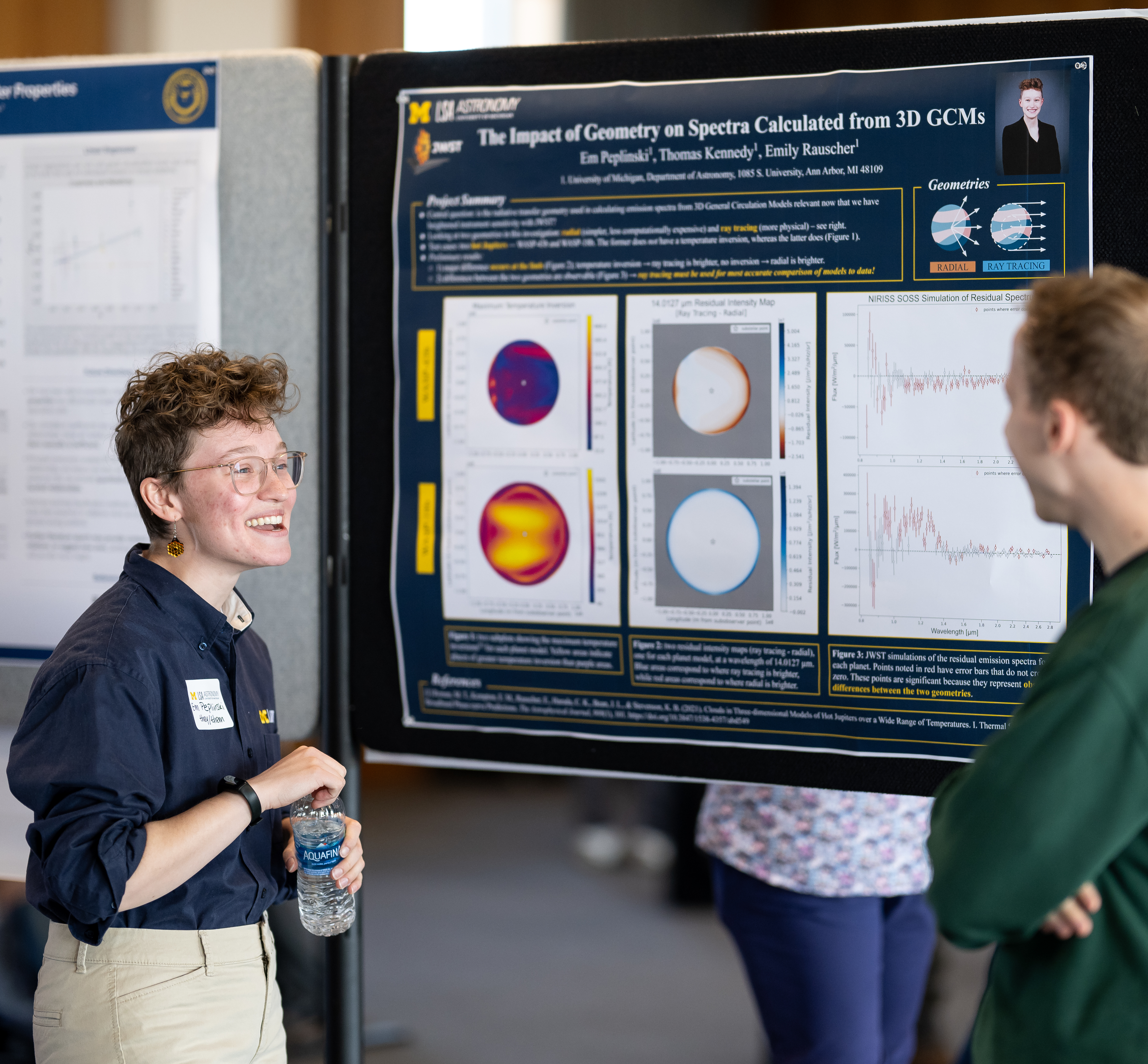
JWST has allowed us greater sensitivity to exoplanet atmospheres than ever before, and this invites a re-evaluation of our assumptions in spectral modeling. In this project, we investigated the importance of limb effects — darkening and brightening — in hot Jupiter emission spectra. We did so through analysis of multiple different ray geometries with both 1D and 3D planet models, ultimately comparing the error produced by geometries that do not correctly capture limb effects to JWST precision.
- Lightning talk, presented at the 2023 Great Lakes Exoplanet Area Meeting
- Poster, presented at the 2024 University of Michigan Astronomy Undergraduate Research Symposium
Creating JWST emission spectra from 3D exoplanet models
My first research project, wherein I devised a method for making simulated JWST emission spectra of our groups' 3D atmosphere models. The abstract and full poster can be viewed here.
- Poster, presented at the 2023 University of Michigan Astronomy Undergraduate Research Symposium


